
01
Impact of losing cooling
In November 2025 a cooling equipment failure at a CyrusOne data center pushed room temperature above 38 °C, and futures trading at CME Group was halted for about 10 hours.
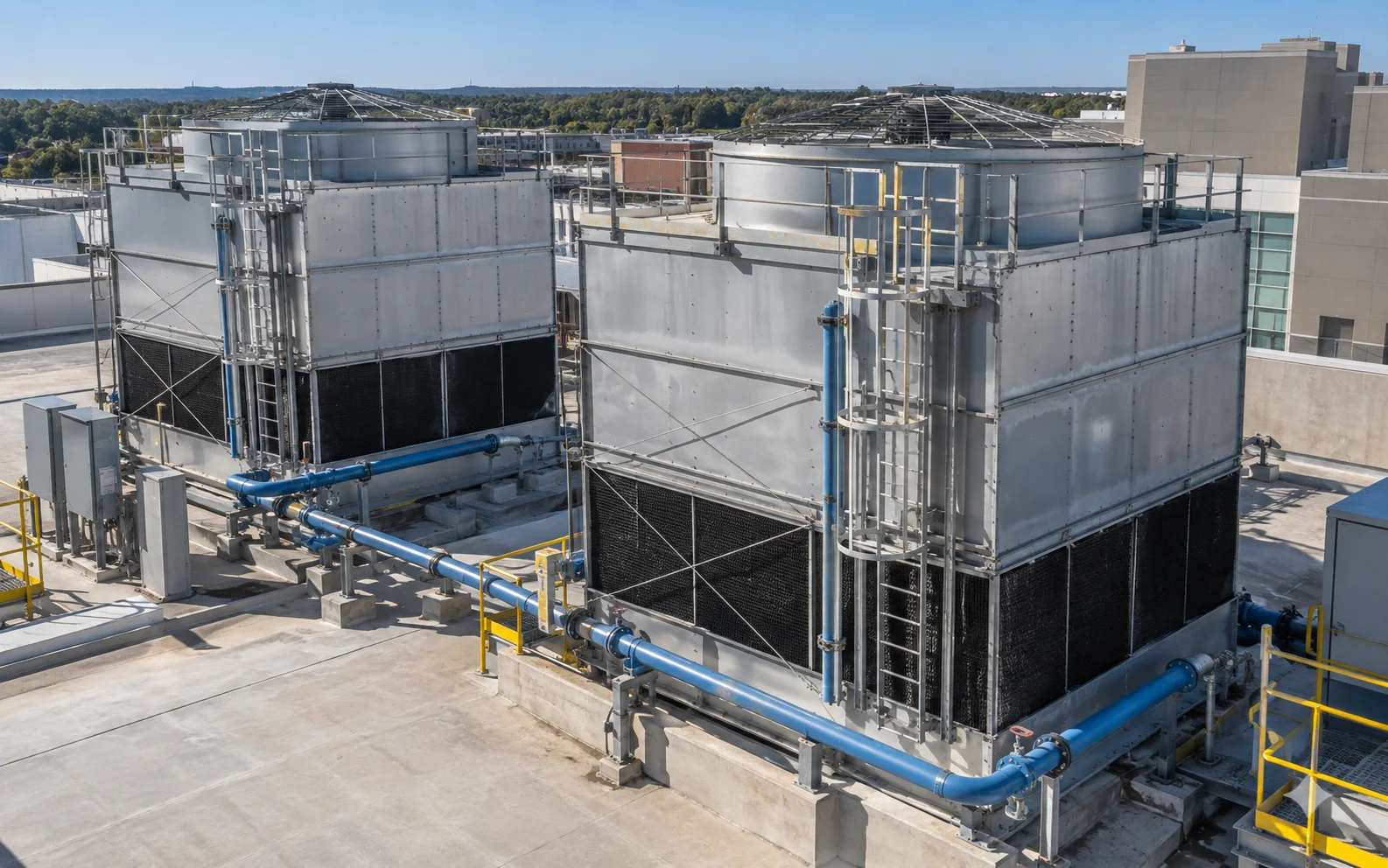
Tower fan motors and VFDs are watched for degradation that reduces cooling efficiency and uptime.
Cooling tower fans release the heat of the cooling water to the atmosphere. In this scenario SV500 analyzes the voltage and current signals of the motors and VFDs that drive cooling tower fans to detect abnormalities in the fans and motors early.
Cooling tower fans sit in hard-to-reach places such as rooftops, so checking each one is difficult.
In November 2025 a cooling equipment failure at a CyrusOne data center pushed room temperature above 38 °C, and futures trading at CME Group was halted for about 10 hours.
It is hard to see in real time the condition of cooling tower fans installed in several places such as rooftops.
SV500 uses ESA to analyze the electrical signals of fan drive motors and VFDs and diagnose abnormalities in the fans and motors.
Detects fan mechanical unbalance, blade and vane damage and flow turbulence.
Detects bearing problems, broken rotor bars, static and dynamic eccentricity, shaft misalignment, soft foot and load-related problems.
For fans driven by a VFD, SV500 analyzes voltage, current and frequency signals on the VFD secondary (output) side at 8 kHz to predict and diagnose potential faults.
Machine learning learns the normal state of each asset and judges condition with thresholds that adapt to load. Criteria matched to each asset and load condition are applied instead of fixed thresholds.
The equipment web server dashboard shows status per diagnostic parameter in real time, so condition can be checked without a site visit, and data can be integrated with upper-level systems over Modbus RTU, Modbus TCP, MQTT and RESTful API.
Abnormalities in scattered cooling tower fans can be identified early and remotely so maintenance can be planned.
Detects potential failures early to minimize unexpected incidents and risk.
Diagnostic data helps predict and optimize maintenance schedules.
Higher operating efficiency helps reduce energy consumption, maintenance cost and downtime.
Continuous monitoring and early detection support availability, maintenance and energy efficiency.
Illustrative ranges, not verified SV500 results. Actual outcomes depend on site conditions and corrective actions; PoC validation is required.
Name the one that matters most and we will set out the diagnostics and measurement points for it.
Request a demo