
01
Long recovery time
As of late 2021, a new generator step-up transformer takes 52 to 70 weeks to procure and install, and one analysis estimates that a 250 MW generator idle for 52 weeks could lose over USD 13 million in revenue.
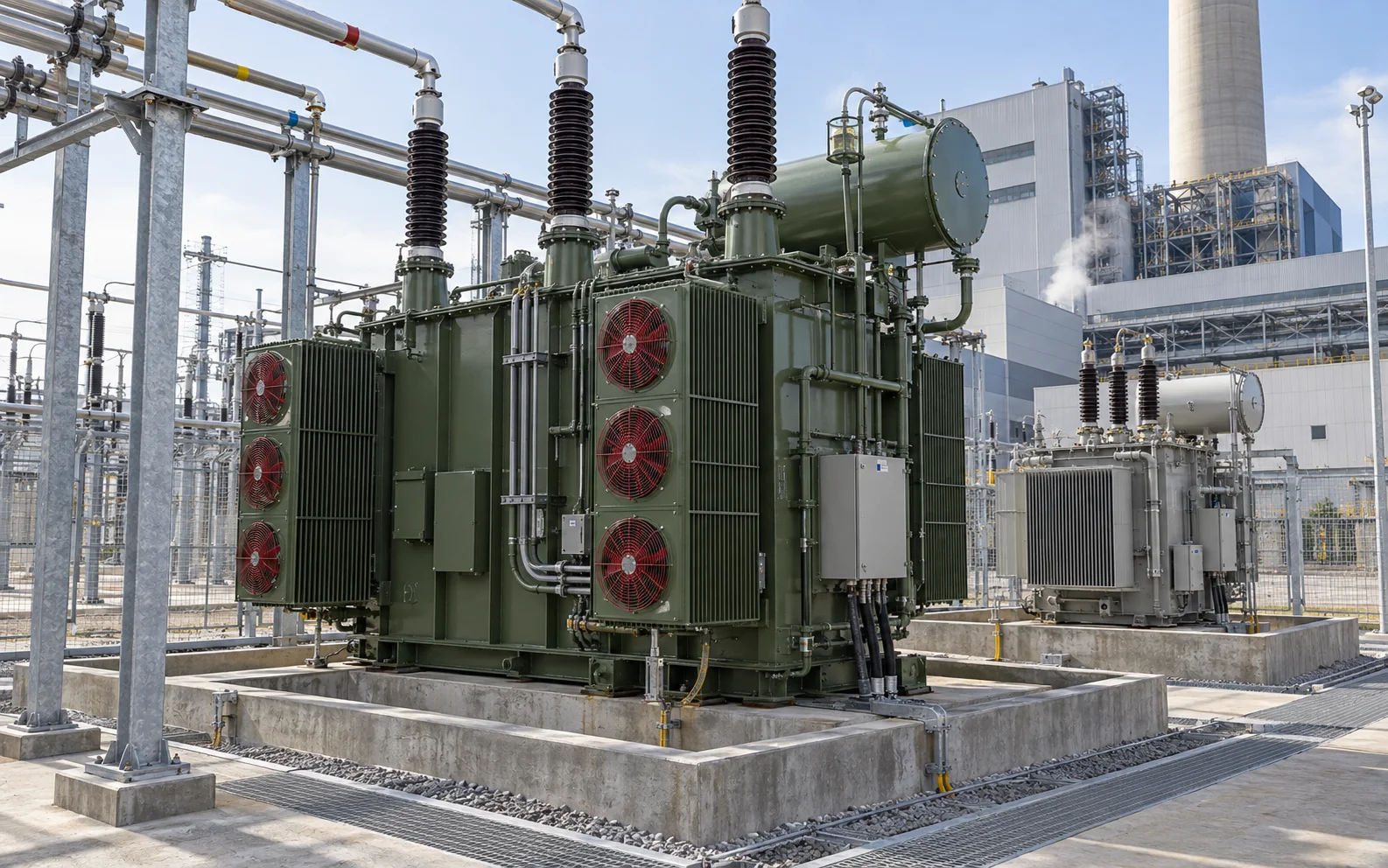
Transformer stress, winding and tap changer indicators help judge remaining margin on aging assets.
The main transformer (generator step-up transformer, GSU) raises generated power to transmission voltage for the grid, station service transformers power auxiliaries such as feed pumps and draft fans, and start-up transformers power the station during start-up and shutdown. In this scenario SV500 measures and analyzes three-phase voltage and current with PTs and CTs on the transformer secondary side to diagnose signs of abnormality and causes of failure, and monitors power quality at the same time.
A transformer problem can block generator output or cut power to auxiliaries, which affects plant operation.
As of late 2021, a new generator step-up transformer takes 52 to 70 weeks to procure and install, and one analysis estimates that a 250 MW generator idle for 52 weeks could lose over USD 13 million in revenue.
A CIGRE survey found windings the most common failure location in generator step-up transformers (48%), while bushing failures most often led to fire or explosion.
At the US Susquehanna nuclear plant, an internal fault in the Unit 2 start-up transformer caused a fire, and the unit could not restart until it was replaced.
SV500 acquires three-phase voltage and current on the transformer secondary side at 8 kHz and uses ESA to analyze transient and steady states and diagnose signs of abnormality and power quality of the transformer.
Analyzes mechanical abnormalities such as winding movement and structural loosening, and insulation degradation.
Detects insulation defects and leakage current in bushings, and measures ground leakage current to monitor ground faults.
For transformers with an on-load tap changer (OLTC), detects contact wear, misalignment and control errors.
Records sudden load changes, sag/swell, switching transients, spikes, overvoltage and overcurrent as events, and analyzes THD and voltage and current imbalance in real time.
Machine learning learns the normal state of each asset and judges condition with thresholds that adapt to load.
Measured values, power quality (harmonics, waveforms, ITIC evaluation) and diagnostic status can be checked on the web in real time, and data integrated with upper-level systems over Modbus RTU, Modbus TCP, MQTT and RESTful API.
Signs of abnormality in these transformers can be identified early, and maintenance planned according to actual condition and risk.
Detects potential failures early to minimize unexpected incidents and risk.
Supports the shift from time- based (TBM) to condition-based maintenance (CBM).
Diagnostic data helps predict and optimize maintenance schedules.
SV500 analyzes the voltage and current signals on the secondary side of the main transformer and the station service and start-up transformers with ESA to detect winding abnormalities, bushing insulation defects, ground faults and tap changer abnormalities early, and records power quality events at the same time to support condition-based maintenance.
Name the one that matters most and we will set out the diagnostics and measurement points for it.
Request a demo