
01
Impact of losing cooling
In November 2025 a cooling equipment failure at a CyrusOne data center pushed room temperature above 38 °C, and futures trading at CME Group was halted for about 10 hours.
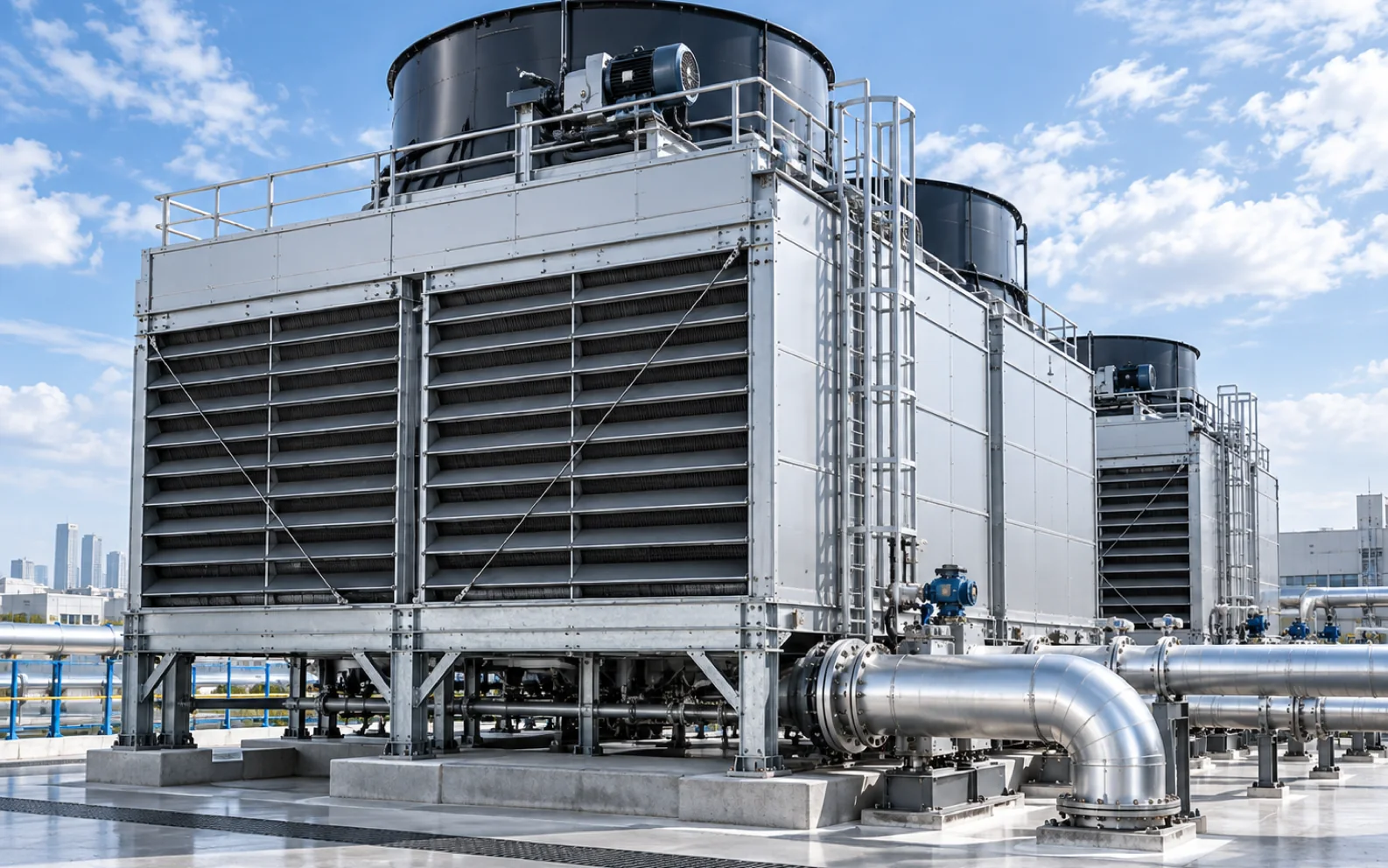
Fan motors and VFDs are watched to keep heat rejection capacity available.
Cooling tower fans release the heat of the cooling water to the atmosphere. In this scenario SV500 analyzes the voltage and current signals of the motors and VFDs that drive cooling tower fans to detect abnormalities in the fans and motors early.
Cooling tower fans sit in hard-to-reach places such as rooftops, so checking each one is difficult.
In November 2025 a cooling equipment failure at a CyrusOne data center pushed room temperature above 38 °C, and futures trading at CME Group was halted for about 10 hours.
It is hard to see in real time the condition of cooling tower fans installed in several places such as rooftops.
Analyzes the VFD’s voltage output and current waveforms to diagnose faults in rectifier diodes, DC-link capacitors, and switching semiconductors (SCRs or IGBTs). Also analyzes the condition of power supply and power quality of the VFD.
Without installing additional sensors on the equipment, analyzes the voltage and current waveforms supplied to the motor to diagnose mechanical faults (Cavitation, Soft Foot, Bearing, Vibration, etc.), electrical faults (Stator, Cable connection, Heat, Noise, etc.) and Load fluctuation fault.
For power quality diagnosis, saves power quality indicators such as voltage, current, interruptions, sags, harmonics, etc. in trend data.
Performs all diagnostic analysis directly on the edge device. Built-in memory and storage—2GB DDR, 8GB eMMC, and SD card support up to 256GB—enable long-term storage of diagnostic data and waveforms without transmitting them to a server. The built-in web-based UI/UX provides access to real-time data, diagnostic result of the equipment, diagnostic data of the power quality, alarm events, reports and etc. without a separate server.
Abnormalities in scattered cooling tower fans can be identified early and remotely so maintenance can be planned.
Detects potential failures early to minimize unexpected incidents and risk.
Diagnostic data helps predict and optimize maintenance schedules.
Higher operating efficiency helps reduce energy consumption, maintenance cost and downtime.
Continuous monitoring and early detection support availability, maintenance and energy efficiency.
Illustrative ranges, not verified SV500 results. Actual outcomes depend on site conditions and corrective actions; PoC validation is required.
Name the one that matters most and we will set out the diagnostics and measurement points for it.
Request a demo