
Machining and forming
CNC spindle and feed motors, presses and hydraulic units, extruders and mixers
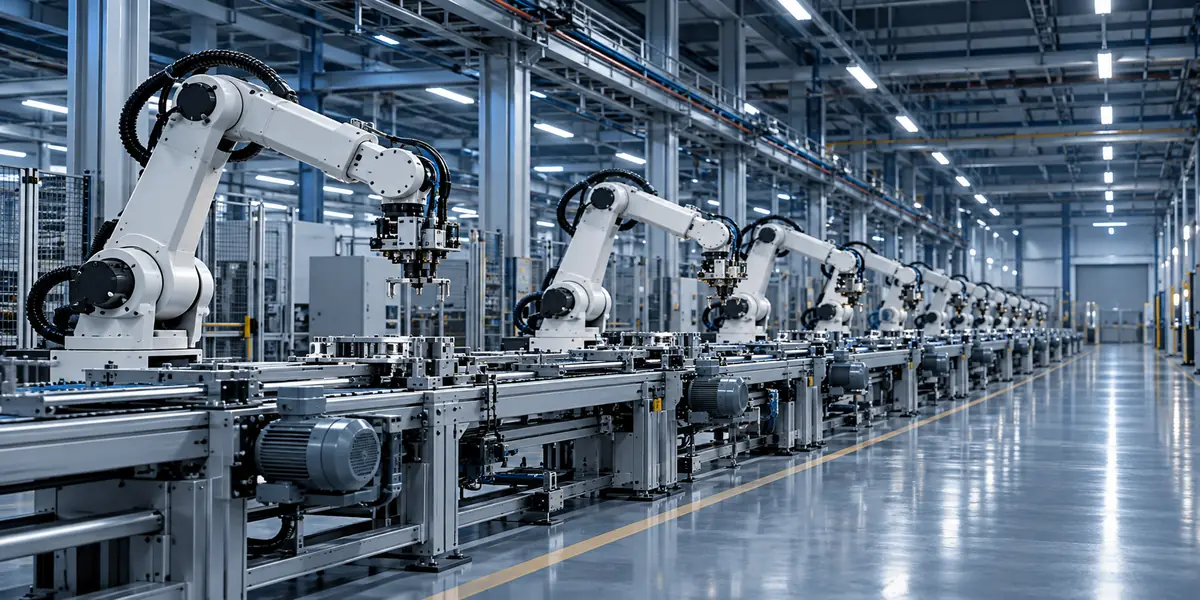
AI MANUFACTURING / GENERAL MANUFACTURING
Motors and inverters are central to automotive, metal, machinery, chemical, food and packaging plants. edgeSV identifies developing anomalies in rotating equipment and critical drives to support stable production and more efficient maintenance.
General manufacturing sites contain equipment of many types and ages, with different maintenance maturity by process. Unexpected failures in presses, CNC machines, conveyors, compressors or pumps can interrupt work and delay delivery. PLCs show operating state but may not provide sufficient degradation trends, and adding sensors to legacy equipment is often difficult.
CNC spindle and feed motors, presses and hydraulic units, extruders and mixers
Conveyors, rollers, geared motors and packaging equipment
Air compressors, chillers, pumps, fans and boiler feedwater pumps
Dust collectors, exhaust fans, MCCs, inverters and power quality
Use motor and inverter signals to compare condition and load changes and prioritize inspections.
Use developing anomaly indicators to coordinate inspection and maintenance with the production schedule.
Start with critical assets and review how condition data can connect with SCADA, MES and FEMS.
The following are examples for reviewing industry applications. Actual diagnostic scope depends on motor and inverter design, load characteristics, measurement location and field-validation results.
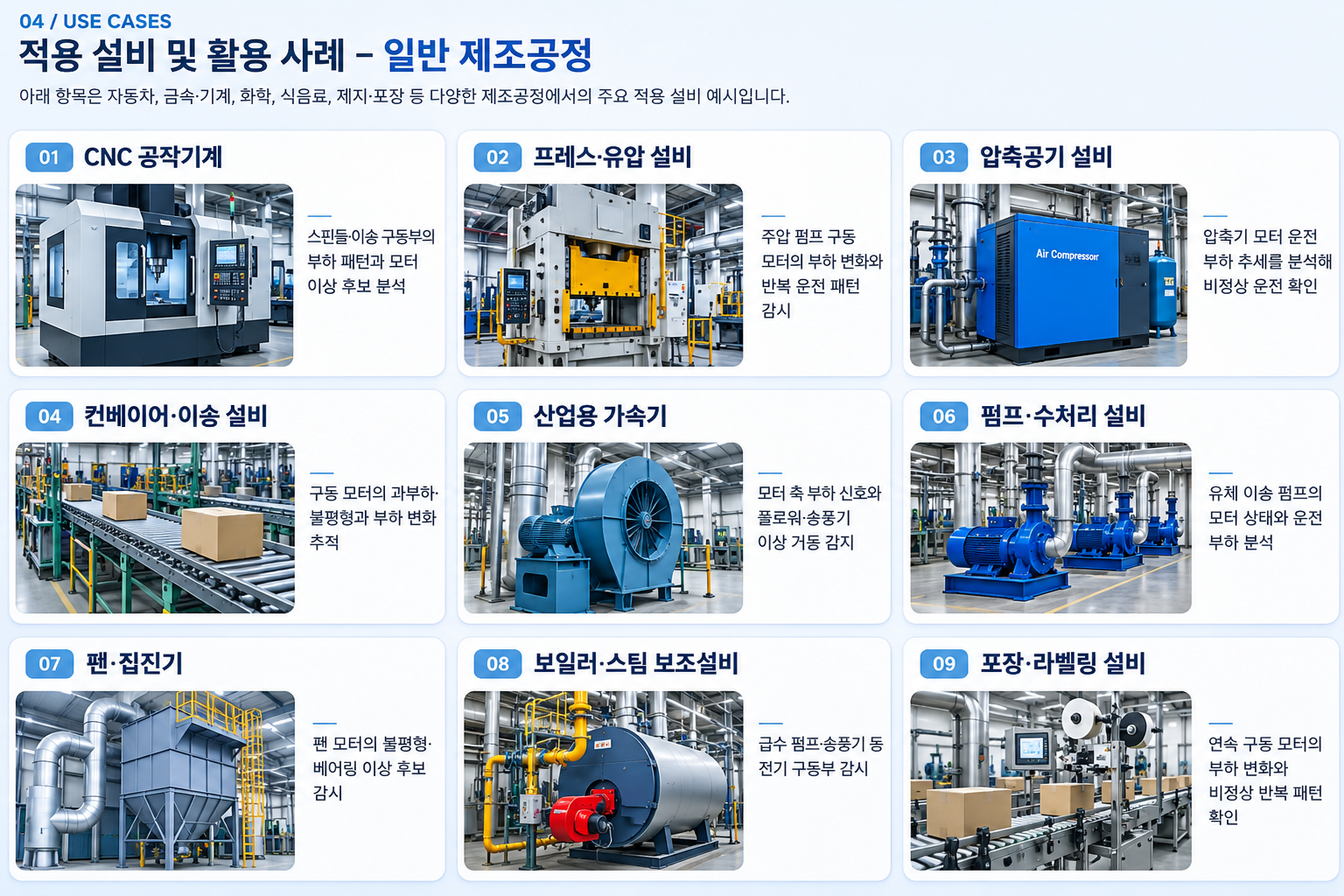
Analyze spindle and feed-drive load patterns and motor anomaly candidates
View detailed page › Monitor load changes and repetitive patterns in hydraulic-pump motors
View detailed page › Analyze compressor motor operation and load trends to identify abnormal operation
View detailed page › Track drive-motor overload, imbalance and load changes
View detailed page › Use motor-side load signals to identify possible gearbox anomalies
View detailed page › Analyze motor condition and operating load in fluid-transfer pumps
View detailed page › Monitor fan-motor imbalance and bearing-anomaly candidates
View detailed page › Monitor electrical drives such as feedwater pumps and blowers
View detailed page › Check load changes and abnormal repetitive patterns in continuous-drive motors
View detailed page ›A hydraulic-press pump motor shows a load pattern that differs from its normal repetitive cycle.
edgeSV highlights the trend while the maintenance team reviews hydraulics, valves and operating conditions.
The drive is inspected during scheduled maintenance, and condition changes before and after the work are compared.
※ This is an illustrative scenario and does not represent an actual customer validation result or a confirmed failure-prediction date.
Factories with critical equipment driven by electric motors or inverters can be reviewed first. Measurement conditions and diagnostic goals are defined for industries such as automotive parts, metalworking, chemicals, food and packaging.
Where existing systems focus on operation and fault alarms, drive-condition data can add depth. Duplicate functions and integration scope are reviewed in advance.
Baseline data must distinguish repetitive cycles and load conditions. A field PoC confirms diagnostic feasibility rather than declaring a mechanical fault from a short measurement.
No. Savings require action after inefficient operation is identified, such as adjusting conditions, performing maintenance or improving control.
We recommend a pilot on one to three critical assets, followed by expansion after data quality, alarm usefulness and operational value are verified.
CNC · Hydraulic equipment · Conveyors · Compressors · Motors · Pumps
We can agree on measurement points and PoC scope using your equipment list, single-line diagram, motor and inverter specifications, and operating conditions.